
UK Fighter TKV Shares Harrowing Family History of Persecution Under Former Zaire Regime
Boxer reveals his grandfather’s killing and father’s targeting under Mobutu-era Zaire, tracing how political violence shaped his family’s journey.
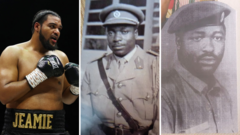
LONDON — British heavyweight boxer Tshiembe Katembo Vuvu, known professionally as TKV, says his family’s life was marked by political persecution in Zaire, recounting in a recent interview that his grandfather was killed and his father targeted under the rule of former president Mobutu Sese Seko. The athlete says the experiences shaped his upbringing, identity and motivation as he continues his rise in the United Kingdom’s boxing circuit.
TKV, who competes out of London, shared his family’s story publicly for the first time while discussing his Congolese roots and the personal hardships that preceded their relocation. His account offers a rare glimpse into the long-lasting impact of political repression under Mobutu’s 32-year rule, which ended in 1997 but continues to influence the lives of Congolese families abroad.
⸻
A Family Marked by Violence and Displacement
According to TKV, his family’s ordeal began in the 1970s and worsened through the 1980s, a period when Mobutu’s government faced internal dissent and was widely criticized for human-rights abuses. TKV says his grandfather was killed during that era, allegedly due to political associations that put him at odds with authorities.
He adds that his father later became a target as well, forcing the family to move frequently in search of safety. “My dad was constantly looking over his shoulder,” TKV said. “He didn’t want the same thing to happen to us.”
The family eventually left Zaire, seeking stability and security abroad. Although TKV was not born during the early years of the conflict, he says the trauma and fear endured by his parents influenced his childhood and outlook.
⸻
Mobutu’s Rule: A Period of Turbulence and Repression
Mobutu Sese Seko ruled Zaire—now the Democratic Republic of the Congo—from 1965 to 1997 after seizing power during the Congo Crisis. Backed at times by Western governments during the Cold War, Mobutu maintained authority through a centralized security apparatus, patronage networks and political suppression.
Human-rights organizations and historians document numerous cases of forced disappearances, extrajudicial killings and intimidation of political opponents during his tenure. Families associated with rival political movements, student activism or regional opposition were often subject to harassment, surveillance or violence.
Experts say TKV’s account aligns with broader patterns described in historical records. Although individual cases are difficult to verify decades later, the general climate of fear experienced by families targeted under the regime is well established.
⸻
Growing Up in the Shadow of a Violent Past
TKV, now competing professionally in the UK, says his family’s past shaped his values—and his approach to sport. He describes his upbringing as disciplined, focused and deeply influenced by stories of survival shared by his parents.
“My dad wanted me to understand where we came from,” he said. “He wanted me to know why he worked so hard to give us a different life.”
The boxer says that awareness gave him a sense of responsibility, pushing him to make the most of opportunities that his father and grandfather did not have. He credits his parents with instilling in him resilience and the determination to pursue boxing at a professional level.
⸻
A Journey From Displacement to Opportunity
The move from Central Africa to Europe marked a dramatic shift in the family’s circumstances. TKV says his parents were determined to rebuild their lives, learn new languages and adapt to a different society. They encouraged their children to embrace both their Congolese heritage and their new environment.
Sport, TKV says, provided structure and stability during his adolescence. Boxing became a central focus, offering a path toward personal achievement and a way to honor the struggles of his family’s past.
He debuted professionally in the UK’s heavyweight division and has since worked to establish himself within the country’s competitive boxing landscape.
⸻
Perspectives From Historians and Analysts
Historians say that many Congolese families living in Europe and elsewhere share similar stories of violence, forced migration and political pressure under Mobutu’s regime. Dr. Amani Kabeya, a London-based researcher specializing in Central African history, says accounts like TKV’s reflect the lingering intergenerational effects of authoritarian rule.
“Mobutu’s government impacted not just individuals directly involved in politics but entire families,” Kabeya said. “The trauma often carries forward into future generations, influencing identity, memory and the way families talk about their past.”
Analysts emphasize that the Democratic Republic of the Congo continues to deal with the long-term consequences of Mobutu’s rule, including political fragmentation, security challenges and ongoing struggles for stability.
⸻
Public Reactions and Broader Significance
TKV’s decision to share his family’s story has drawn interest from boxing fans and community groups who view his rise as emblematic of resilience in the face of historical trauma. Supporters say that his openness about his family’s experience humanizes broader discussions about migration, conflict and diaspora identity.
Some Congolese community leaders in the UK say that young people benefit from hearing stories that connect them to their heritage. They argue that narratives from the diaspora help preserve cultural memory and highlight the political histories that forced many families to relocate.
Others caution that individual accounts, while powerful, should be understood within complex and diverse historical contexts. They stress the importance of balanced reporting and careful documentation when recounting events tied to political violence.
⸻
TKV’s Focus Remains on Boxing—but His Story Resonates
As TKV prepares for upcoming bouts, he says he carries his family’s legacy with him into the ring. He credits his father’s resilience and his grandfather’s memory as sources of strength and motivation.
“I fight because I come from fighters,” he said. “Their struggle gives me purpose.”
He hopes that sharing his family’s experience encourages others with similar histories to speak openly about their journeys. For TKV, telling the story is not about politics, he says, but about honoring the sacrifices that shaped his life.
For now, the boxer continues to rise within the UK heavyweight scene, determined to build a career rooted in both personal ambition and the enduring legacy of a family shaped by one of Central Africa’s most turbulent political eras.


