
France Revives Military Service, Plans 10-Month Volunteer Program for Youth Starting 2026
President Macron announces a new voluntary national service, aiming to bolster national defense amid rising security threats from Russia.
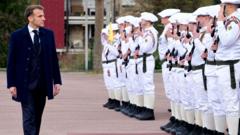
VARCES-ALLIÈRES-ET-RISSET, France — France will reintroduce a form of military service in the summer of 2026, President Emmanuel Macron announced Thursday, a move that marks a significant shift in the nation's defense strategy nearly three decades after conscription was abolished .
The new program will be voluntary and primarily target citizens aged 18 and 19 for a 10-month paid commitment . Macron unveiled the plan at an infantry brigade in the French Alps, framing it as a necessary response to "accelerating threats" on the global stage and a way to harness the "thirst for engagement" among French youth .
A "Hybrid Army" for Modern Threats
The voluntary service is designed to create a three-tiered "hybrid army," comprising professional soldiers, reservists, and the new national service volunteers . Macron emphasized that this model "corresponds to the threats and risks ahead" and stated unequivocally that France "cannot return to the time of conscription" .
The initiative is part of a broader European trend, with Macron noting it is "inspired by practices of our European partners" like Germany and Denmark, who are also enhancing their military recruitment efforts . This continental reassessment of defense is driven by growing concerns over Russian aggression and shifting U.S. foreign policy priorities .
Program Details and Recruitment Goals
The program will begin gradually, aiming to recruit 3,000 volunteers in 2026 . The government's ambition is to scale this number up to 10,000 annual recruits by 2030, with a long-term vision of reaching 50,000 youth by 2035-2036 .
Participants will be paid a minimum of €800 per month and receive food, accommodation, and a 75% discount on rail travel . Their deployment will be restricted to French national soil and overseas territories, including participation in domestic security operations like Operation Sentinelle, and will not include deployment to foreign conflicts such as Ukraine . While the vast majority of volunteers will be 18- and 19-year-olds, a minority of spots will be reserved for individuals up to age 25 with specific skills in engineering or medicine .
Context: Alarming Warnings and Political Reactions
The announcement follows a period of heightened alarm in France about the security landscape. Last week, France's armed forces chief, Gen. Fabien Mandon, sparked political uproar by stating the nation must be ready "to lose its children" and that Russia is "preparing for a confrontation with our countries by 2030" .
Macron and his government have since worked to temper these comments, with the president explicitly stating Tuesday that the new service is not about "sending our young people to Ukraine" . The political reaction to the new service has been mixed. Sébastien Chenu, an MP for the far-right National Rally party, said the plan was "going in the right direction" . In contrast, Clémence Guetté of the left-wing La France Insoumise party argued, "France isn't at war and this can't be the priority for young people" .
A Broader European Shift
France's decision places it firmly within a wider movement across Europe to bolster military manpower. Countries like Latvia, Lithuania, and Sweden have reinstated conscription in recent years, while Denmark has extended its terms . Germany is planning a new voluntary military service model, and Belgium has begun inviting 17-year-olds to volunteer .
This shift is a direct response to the threat posed by Russia. As Macron told RTL radio, "The day that you send a signal of weakness to Russia... it will continue to advance" . The French armed forces currently have approximately 200,000 active personnel and 47,000 reservists. The goal is to increase these numbers to 210,000 active personnel and 80,000-100,000 reservists by 2030, with the new volunteer service acting as a key reservoir for these reserves .
Public Opinion and the Road Ahead
An Elabe survey this week found that 73% of the French public supports the voluntary military service, though support was lowest among those aged 25-34, at 60% . In random street interviews conducted by the BBC, opinions varied. A 22-year-old student named Louis said, "It's a good thing... it can help make the army bigger, but it's also a way to love your nation more" . Another student, Lalie, 21, disagreed, saying, "I think there are more important issues," such as youth mental health and financial struggles .
The program, which will cost an estimated €2 billion, effectively ends Macron's previous Universal National Service, a civic engagement scheme that was widely criticized as ineffective . The new military service represents the most significant step in France toward remilitarizing its civilian population since conscription was ended by President Jacques Chirac in 1997 .


