
Singapore Executes Three for Drug Trafficking Amid Renewed Capital Punishment Debate
The city-state carries out two executions in 48 hours, defending its strict anti-drug laws as activists condemn the "shocking" pace.
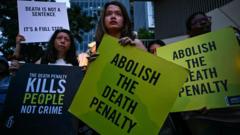
SINGAPORE — Singapore executed two men for drug trafficking on Wednesday and a third on Thursday, authorities confirmed, carrying out capital sentences amid ongoing international scrutiny of its use of the death penalty. The Central Narcotics Bureau (CNB) stated the men were convicted under the Misuse of Drugs Act, which mandates death for trafficking specific quantities of controlled substances. The executions, carried out at Changi Prison, bring the total number of people put to death for drug offenses in Singapore this year to at least four.
Human rights groups identified the executed individuals as Nazeri bin Lajim, 64, and Mohd Aziz bin Hussain, 57, on Wednesday, followed by Farid bin Mat, 45, on Thursday. All three were convicted of trafficking diamorphine, the controlled substance defined as pure heroin under Singaporean law. Their executions mark a continued application of what the government describes as a "zero-tolerance" approach to drugs, a policy it says is crucial for protecting public safety.
Details of the Cases and Final Appeals
According to court documents and statements from rights groups, Nazeri was convicted in 2017 of trafficking approximately 33 grams of diamorphine. Mohd Aziz was convicted in 2018 for trafficking around 50 grams. Farid was convicted in 2019 for his role in a transaction involving about 50 grams.
All three men had recently exhausted their final avenues of appeal. The Court of Appeal dismissed Farid's last-minute application on Tuesday. Similarly, Nazeri and Mohd Aziz saw their appeals for clemency rejected by Singapore's president, following the cabinet's advice, in recent weeks.
In a statement, the Central Narcotics Bureau said, "Capital punishment is used only for the most serious crimes, such as the trafficking of significant quantities of drugs which cause very serious harm to addicts, their families and society." The bureau did not disclose the specific method of execution, but Singapore typically carries out capital punishment by long-drop hanging.
Government Stance vs. International Criticism
Singapore's government maintains that its strict drug laws, including the death penalty, are a cornerstone of its success in keeping drug abuse rates low and society safe. Officials frequently cite the country's low rates of drug-related crime compared to other nations in the region as validation for the policy.
"The death penalty is part of Singapore's comprehensive harm prevention strategy which targets both drug demand and supply," the CNB statement continued. This position is consistently echoed by senior government ministers who argue that the law acts as a powerful deterrent against major drug syndicates.
However, these latest executions have drawn immediate and strong condemnation from international human rights organizations and United Nations experts. Activists argue there is no conclusive evidence that the death penalty deters drug crime more effectively than other punishments.
A Condemnation from Rights Groups
“In a week, Singapore has hanged three people in utter disregard for their right to life,” said Maya Foa, director of the non-profit organization Reprieve, which opposes the death penalty. “This is a shocking escalation in Singapore’s use of the death penalty, all for non-violent drug offenses.”
The U.N. Human Rights Office has repeatedly called on Singapore to halt executions for drug-related crimes, stating they do not meet the threshold of the "most serious crimes" under international law. They argue that the mandatory death sentence removes judicial discretion to consider individual circumstances, such as the defendant's role or potential coercion.
Chiara Sangiorgio, a death penalty expert at Amnesty International, stated, "The death penalty is never the solution. It will not rid Singapore of drugs. These executions are a violation of the right to life and the worst form of cruel, inhuman and degrading punishment."
Local Activists and Family Grief
While public protest is rare in Singapore, a small group of local activists has consistently advocated for the abolition of the death penalty. They held a vigil this week outside the prison where the executions were carried out.
Kirsten Han, a Singaporean journalist and anti-death penalty activist, reported on the emotional toll on the families. "They are grieving, they are in pain," Han said. "The state is taking away a life, and with that comes a lot of trauma for the people left behind."
The families of the executed men received notification of the execution dates only weeks in advance, a standard practice that activists say causes immense psychological distress. They are now left to arrange for last visits and funeral preparations under a tight, state-imposed timeline.
Singapore in a Global Context
Singapore is one of a small number of countries—including China, Iran, and Saudi Arabia—that continue to carry out executions for drug offenses. Most nations worldwide have abolished capital punishment in law or practice.
According to data from Amnesty International, Singapore resumed executions in March 2022 after a two-year hiatus during the COVID-19 pandemic. Since then, it has executed at least 15 individuals, all for drug trafficking. The pace of executions has increased compared to the years immediately preceding the pandemic.
The city-state's stance frequently places it at odds with its neighbors. Malaysia, for example, recently abolished the mandatory death penalty and is reviewing all such sentences. Thailand has legalized cannabis, and the Philippines, under a previous administration, had halted executions.
Legal Challenges and Policy Debates
These executions are unlikely to be the last in the near future. Several other individuals are known to be on death row in Singapore for similar drug offenses, and their appeals are pending. The government shows no sign of deviating from its long-standing policy.
The debate is set to continue on the international stage. Singaporean officials are expected to continue defending their legal sovereignty and the right to set domestic policies they believe protect their citizens. Meanwhile, human rights pressure and diplomatic lobbying from Western nations and U.N. bodies are expected to intensify.
The ultimate question remains whether internal advocacy, coupled with shifting regional norms, will eventually prompt a policy review in Singapore, or if the state will continue to uphold what it sees as a non-negotiable pillar of law and order.


