
Hong Kong's Deadliest Fire in Decades Kills 128, Exposes Systemic Safety Failures
Flammable scaffolding and non-functioning alarms fueled the rapid spread of the preventable tragedy in a Tai Po housing estate, sparking public outrage and government investigations.
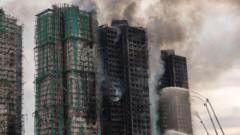
HONG KONG — A devastating fire that ripped through a public housing estate in Hong Kong's Tai Po district this week has killed at least 128 people, making it the city's deadliest blaze in decades and igniting public anger over alleged safety failures and gross negligence . The fire, which started on November 25, 2025, rapidly engulfed seven of the eight high-rise towers at the Wang Fuk Court complex, fueled by highly flammable bamboo scaffolding and construction netting .
Hong Kong's Secretary for Security, Chris Tang, warned that the death toll could rise further, with about 200 people still unaccounted for and 79 others injured . The disaster has prompted mass mourning, the arrest of three construction company officials, and immediate government promises of a comprehensive investigation into the preventable tragedy .
Rapid Inferno and Failed Safety Systems
The fire began at approximately 2:51 p.m. local time on Wednesday, originating on the bamboo scaffolding surrounding the buildings . The flames, intensified by polystyrene foam panels and green construction netting, shot up the exterior of the towers within minutes . The use of these highly combustible materials, which police suspect did not meet fire resistance standards, allowed the blaze to jump between the closely packed buildings uncontrollably .
A critical systemic failure emerged as authorities confirmed that fire alarms in all eight blocks of the housing estate did not function effectively during the emergency . Multiple survivors reported they never heard alarms and were forced to rush door-to-door to warn their neighbors, losing precious evacuation time . The intensity of the fire created extreme conditions, with temperatures reaching 500°C (932°F) at its peak and some sections of the buildings remaining above 200°C even after the flames were largely extinguished .
A Vulnerable Community and Heroic Rescue Efforts
The Wang Fuk Court complex, built in the 1980s, was home to approximately 4,800 residents, nearly 40% of whom were aged 65 or older . This demographic profile significantly contributed to the high casualty count, as many elderly residents faced physical challenges during evacuation . The complex was undergoing a major renovation project valued at about $42.43 million, which had enveloped the buildings in the very materials that accelerated the disaster .
More than 2,300 firefighters battled the blaze for over 24 hours before bringing it under control, in one of Hong Kong's largest-ever fire response operations . Firefighters faced immense dangers, including falling debris from collapsing scaffolding and extreme heat that prevented access to upper-floor apartments for hours . The fire service received 346 requests for assistance during the crisis and managed to handle 296 of them . Twelve firefighters were injured during the response, and one, 37-year-old Ho Wai-ho from the Sha Tin Fire Station, lost his life in the operation .
Criminal Investigations and Immediate Arrests
Police have arrested two directors and an engineering consultant, aged between 52 and 68, from the construction company overseeing the renovations . The suspects were detained on suspicion of manslaughter, with police alleging "gross negligence" for using materials that may not have met regulatory standards . Senior Superintendent Eileen Chung stated that protective materials on the building exteriors "did not appear to be fireproof," directly contributing to the uncontrollable spread of flames .
Hong Kong's Independent Commission Against Corruption (ICAC) has also launched an investigation into possible corruption relating to the renovation project . The registered contractor responsible for the maintenance works at Wang Fuk Court is currently involved in 11 other private residential building projects, all of which the Buildings Department has now inspected .
Immediate Relief and Long-Term Support for Survivors
The Hong Kong government has activated a comprehensive emergency response, establishing nine temporary shelters for over 500 displaced residents . Chief Executive John Lee announced an immediate cash subsidy of HK$10,000 (US$1,285) to each affected household and established a HK$300 million (US$38.6 million) support fund for victims .
To address medium-term housing needs, the government is coordinating approximately 1,000 hotel and youth hostel rooms for immediate stays of up to two weeks, followed by 1,800 transitional housing units from the Hong Kong Housing Society . The Social Welfare Department has implemented a "one social worker per household" assistance program, providing emotional support, financial aid, and care services . Medical stations staffed by over 250 doctors and 250 other healthcare professionals from public and private sectors have been set up at all temporary shelters .
Systemic Reforms and Policy Changes
In response to the disaster, the government has launched three working groups to lead inspection, assistance, and residential arrangement efforts . The Buildings Department has initiated a special operation to inspect all buildings undergoing external wall renovations with scaffolding and protective nets, requiring contractors to submit proof of fire retardant properties within seven days .
The Development Bureau has begun discussions with the construction industry on a roadmap to replace bamboo scaffolding with metal scaffolding, a long-debated safety measure that has gained new urgency . The government will also review relevant requirements, guidelines, and legislation regulating scaffolding and associated protective nets, with enhancements expected .
A City in Mourning and Searching for Answers
As families desperately search for missing loved ones, visiting hospitals and community centers where authorities are using photos and DNA sampling to identify the deceased, the city has plunged into mourning . The government has canceled all celebratory events, and flags will fly at half-mast at government buildings . Memorial services and condolence books will be arranged for the public to pay respects .
With the death toll expected to potentially rise further and investigations likely to take three to four weeks, the Wang Fuk Court fire has exposed critical vulnerabilities in Hong Kong's building safety regulations . As one resident surnamed Suen recounted, "I saw one hose trying to save several buildings, and I felt it was far too slow" . His words capture the helplessness felt by many in a tragedy that experts say was preventable, now forcing a reckoning with construction safety standards across the city .


