
Appeals Court Backs Trump’s Authority to Keep National Guard in Washington, D.C.
The U.S. Court of Appeals for the District of Columbia Circuit lifted an injunction that said the troops needed to leave the Nation’s capital by December 11
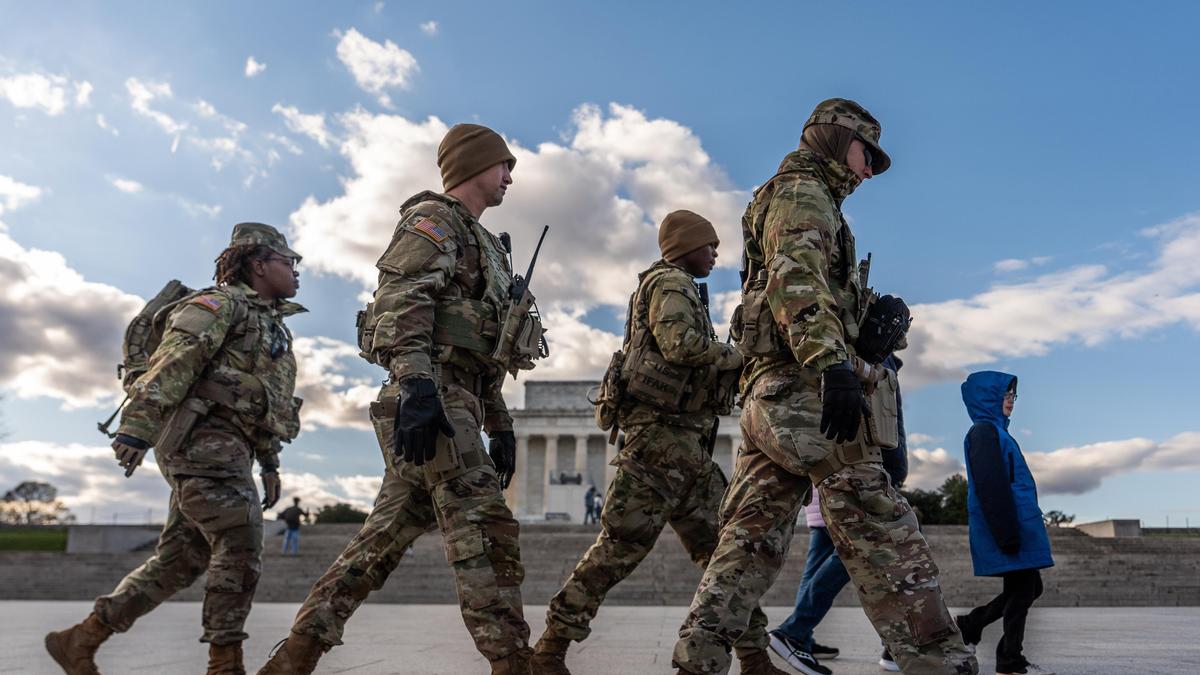
Ruling says federal government acted within legal bounds as debate intensifies over presidential power, local autonomy, and public safety.
A U.S. federal appeals court on Thursday allowed former President Donald Trump’s deployment of National Guard troops in Washington, D.C., to remain in effect, ruling that the federal government acted within its lawful authority during a period of heightened political tension and public safety concerns. The decision, issued by a three-judge panel of the U.S. Court of Appeals for the District of Columbia Circuit, comes after months of legal disputes over who controls the National Guard in the nation’s capital and under what circumstances presidential intervention is justified.
The court held that because Washington, D.C., is not a state and does not possess the same sovereign powers as one, the president maintains broad discretion to activate and deploy the Guard to preserve order. The ruling temporarily ends a legal challenge brought by District officials, who argued that Trump’s deployment was unnecessary, politically motivated, and deprived local authorities of control.
⸻
Background: A Long-Running Power Struggle
Debates over the chain of command for the D.C. National Guard have been ongoing for decades. Unlike state-based Guard units, which operate under the dual control of governors and the federal government, the D.C. Guard is controlled exclusively by the president.
District leaders, including Mayor Muriel Bowser, have long argued that this structure leaves Washington vulnerable to unilateral federal actions that might contradict local judgment.
The dispute escalated during Trump’s presidency, when National Guard deployments were ordered around several major events, including protests, security alerts, and federal property protection in the capital. These deployments triggered extensive public and political scrutiny, raising questions about whether presidents could use the Guard to respond to politically sensitive situations.
⸻
Details of the Court’s Ruling
Court affirms presidential authority
In a 2-1 decision, the appeals court emphasized that the Constitution and established federal statutes confer the president with clear authority over military deployments in the District. Judge Alan Davenport, writing for the majority, stated that “the unique federal status of the District of Columbia places the National Guard under exclusive presidential command absent specific congressional limitations.”
The court also found no evidence that Trump’s decision violated constitutional protections or exceeded the statutory scope of his powers.
Local autonomy concerns rejected
While acknowledging local frustrations, the majority held that “policy disagreements cannot override the legal framework governing federal control of the Guard.” The judges reiterated that Congress—not federal courts—holds the power to modify the chain of command if it deems necessary.
Judge Laura Renner issued a dissent, arguing that unchecked presidential authority risks “inviting deployments untethered to imminent threats,” and urged Congress to review the Guard’s governance structure.
⸻
Reactions From District Officials and Lawmakers
Mayor Bowser expresses disappointment
Mayor Bowser criticized the ruling, stating that the decision “undermines the District’s ability to manage its own public safety and leaves residents vulnerable to federal overreach.”
She renewed calls for D.C. statehood and urged Congress to pass legislation giving the mayor authority over the Guard.
Trump campaign welcomes the decision
Representatives for Trump praised the ruling, arguing it vindicates his administration’s actions and affirms presidential responsibility to “protect the capital during moments of national importance.”
They added that Guard deployments under Trump were aimed at “restoring calm and maintaining necessary security measures.”
Mixed response in Congress
Lawmakers reacted largely along party lines.
Republican lawmakers called the decision “common sense,” emphasizing the need for strong federal authority in Washington.
Democratic lawmakers said the ruling highlights “structural inequities” that prevent District residents from having the same rights as Americans in states.
Sen. Eleanor Holmes Norton, D-D.C., reiterated her push for legislation transferring control of the D.C. Guard to local authorities except during federal emergencies.
⸻
Legal Context: What Precedent Says
D.C. Guard’s unique status
Legal experts note that the D.C. National Guard has never been under mayoral or local control. The president functions as the equivalent of a governor for the District when it comes to military and emergency-management powers.
This arrangement was crafted by Congress when it established the District’s governance system and has remained largely unchanged.
Past deployments under scrutiny
The court’s ruling referenced prior instances, including Guard deployments after the September 11 attacks and during presidential inaugurations, to illustrate the long-standing nature of presidential authority.
However, critics argue that modern political polarization makes it more urgent to examine checks and balances around possible misuse of military forces in domestic settings.
⸻
Security Concerns and Broader Implications
Federal officials cite national security
Senior Defense Department officials defended the continued deployment, saying the Guard remains essential for emergency preparedness, crowd control, cybersecurity operations, and support to federal agencies during large-scale events.
Officials stressed that the deployment is not indefinite and will remain “event-driven and closely monitored.”
Local community reactions varied
Some Washington residents voiced relief, saying Guard presence brings a sense of security in uncertain times. Others expressed discomfort with prolonged military presence near neighborhoods, schools, and public buildings.
Civil rights groups warned that frequent deployments could “blur lines between civilian law enforcement and military intervention,” calling for stricter criteria for activation.
⸻
What Happens Next
Possible Supreme Court review
Legal analysts say District officials may petition the U.S. Supreme Court for review, though the Court has previously been reluctant to intervene in disputes involving federal authority over D.C.
Congressional debate expected
Members of Congress have indicated that the ruling could revive legislative proposals aimed at restructuring D.C.’s governance, including bipartisan calls to reexamine Guard authority, even if consensus remains unlikely.
Long-term questions remain
The appeals court ruling settles the immediate legal dispute but leaves broader political tensions unresolved. As Washington continues to host high-profile events and remains a focal point of national security concerns, the question of who ultimately controls the National Guard—and when and how it should be deployed—will likely continue to shape federal-local relations.


